Most Dead Solar Panels Still Get Landfilled as Trash. Three 2026 State Laws Change Who Pays.

Most of the solar panels retiring in the United States this decade will end up in a landfill, mixed in with construction debris and treated as ordinary trash. Not because that's the right answer. Because in most states it's still the legal one, and it's cheap. A dead module carries silver, copper, aluminum and a lot of glass, but a landfill charges by the ton and a panel weighs about forty pounds, so burying one costs roughly a dollar. Recycling that same module runs twenty to thirty times more. When the cheapest compliant exit is a hole in the ground, that's where the material goes.
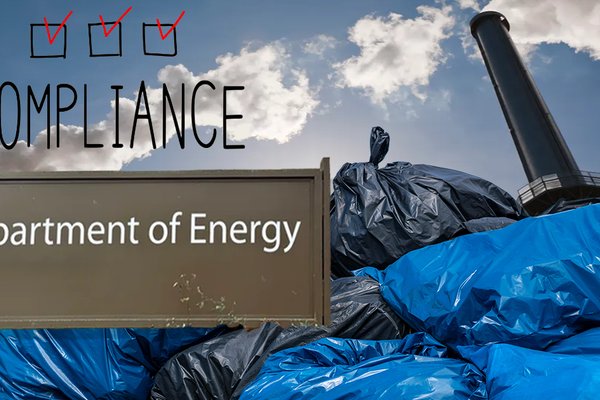
That default is starting to break, one state at a time. In 2026 New Jersey, Texas and North Carolina each moved to make landfilling end-of-life panels illegal, expensive, or somebody's written obligation, while the federal rule that would set a national floor sits stuck in the pipeline. So if you build, finance or operate solar, the live question is no longer whether solar panel recycling becomes mandatory. It's who ends up holding the bill, and when it lands on the balance sheet.
I read waste streams the way I read cargoes: a position is worth something only if there's a buyer, a spec it can meet, and a way to move it. A solar panel at end of life is exactly that kind of position. It looks like an asset on the way in and behaves like a liability on the way out, and the 2026 rules are really an argument about who gets stuck with the difference.
Why the cheapest exit is still a hole in the ground
Start with the gate economics, because they explain everything downstream. A construction-and-demolition landfill charges somewhere near $50/ton [industry range, 2026]. A crystalline-silicon module is mostly glass and aluminum, heavy and low-value, so on a per-panel basis that tipping fee pencils to about a dollar. A recycler has to do real work to beat that: cut the frame, pull the junction box, delaminate the laminate, and separate the glass, silicon and the sliver of silver clean enough to sell. That labor is why a recycler quotes something like twenty to thirty dollars a module to take the same panel [industry range]. The landfill wins on price every time the law lets it compete.
There's a wrinkle that cuts the other way. Some panels are hazardous waste. Per the EPA's end-of-life guidance, heavy metals like lead and cadmium can leach at concentrations that fail the toxicity characteristic leaching procedure, the TCLP test that decides characteristic hazardous waste under RCRA. The catch is that two panels of the same make and model can land on opposite sides of that line, and almost nobody tests, because a "non-hazardous" assumption is cheaper than a lab result. Residential panels usually duck the question entirely under the household-waste exclusion (the same carve-out that lets you drop a household battery in the kitchen bin). So the designation that should raise the cost of careless disposal mostly goes unmeasured.
Now the volume. The country is on track for something on the order of a million tons of cumulative end-of-life panels by 2030, with the published range running from roughly 0.17 up to 1 million tons [per IRENA and EPA]. Set against municipal solid waste, that's a rounding error. But it doesn't arrive like municipal trash, spread thin across a million households. It arrives in slugs: a utility array reaches the end of its economics and a few hundred thousand identical modules come down in one place, in one quarter. That lumpiness is what makes it a project-finance problem rather than a curbside one.
So what's a retired module actually worth? It comes down to three things the spreadsheet can't show you: whether the stream can be sorted to spec, whether a line exists inside freight range, and whether anyone is contractually on the hook to pay for the work. Same object, wildly different value. The spec sheet, not the sales deck, decides which.
No federal floor, and a recycler map full of holes
The rule that would settle a lot of this is coming. It's just late. The EPA has signaled it will fold waste photovoltaic panels into the universal waste framework at 40 CFR Part 273, the same streamlined track it already uses for batteries and lamps. Per Beveridge and Diamond's read of the regulatory agenda, the proposed rule was targeted for early 2026 with a final rule not expected until August 2027, and the timeline has slipped further amid the shutdown. Until it lands, panels are just solid waste in most of the country, hazardous only if someone bothers to run the TCLP. California and Hawaii already classify them as universal waste at the state level. Everyone else is waiting on Washington or writing their own rules.
And the recycler network that would absorb the material is thin and clustered. Freight is the quiet killer here. Because a panel is mostly glass, hauling it long-distance can cost more than the recovered material is worth, so a recycler in Georgia or Arizona does nothing for a decommissioned array in Montana (glass is heavy, and heavy is expensive to move). The map has holes you could drive a flatbed through, and the holes are where the panels get buried.
Then there's the spec problem, which is where I've watched this kind of economics go sideways. On an RDF export book I ran in 2024, a chloride reading came back out of spec at the load port and a forty-thousand-tonne cargo I had modeled as revenue booked as demurrage instead; the position was wrong the day the spec sheet printed. Recovered material is exactly that unforgiving. Mixed chemistries, cracked glass and contaminated laminate drag the output below what a glass or metals buyer will pay, and a stream that can't meet spec stops being a commodity and starts being a disposal cost. The high recovery figures you will read assume feedstock that's already been sorted and de-risked. The stranded panel in the field hasn't been.
This is the same fault line running through the 2026 state battery-recycling laws: the technology to recover the material exists, but whether it pays turns entirely on who is obligated to fund the recovery, and whether that obligation is written down before the asset dies. Without a funded obligation, the cheapest exit wins, and the cheapest exit is the landfill.
What New Jersey, Texas and North Carolina actually changed
Three states, three different tools.
New Jersey's S3399, signed by outgoing Governor Phil Murphy in January 2026, is the first state law to mandate solar panel recycling without leaning on an extended-producer-responsibility scheme. It puts the recycling obligation on the owner, producer or manufacturer, lets the state set a fee schedule, and threatens fines up to $1,000 per violation for improperly dumped residential panels, per Resource Recycling's reporting. The interesting part is the trigger: the law only takes effect 180 days after the state environmental department certifies that adequate in-state recycling infrastructure actually exists, which observers expect around late 2026. It's a mandate that waits for the market to show up first.
Texas took the route that actually moves capital. Its decommissioning statutes now require solar developers to post financial assurance, a bond or letter of credit sized to the full cost of taking the array down and recycling it, and as of January 15, 2026 any facility recycling those components files annual reports with the TCEQ against a certificate-of-recycling system. Hauling panels to a landfill is no longer a clean legal option for a utility-scale operator there. That's the model that changes the numbers, because it forces the end-of-life cost onto the balance sheet at financing, not at decommissioning twenty-five years later.
North Carolina picked the bluntest instrument. Under its landfill-disposal statute, starting December 1, 2026, photovoltaic modules are banned from construction-and-demolition and other unlined landfills; anything not shipped for reuse or recycling has to go to a lined industrial or municipal landfill. It doesn't mandate recycling and it doesn't fund it. It just closes the cheapest hole and lets the economics adjust.
| State | What it now requires | When it bites |
|---|---|---|
| New Jersey | Mandatory recycling; obligation on the owner or maker; fines for improper dumping | After in-state recycling capacity is certified (expected late 2026) |
| Texas | Financial assurance for decommissioning plus recycling; annual recycler reporting to TCEQ | Reporting live since January 2026 |
| North Carolina | PV modules barred from C&D and unlined landfills | December 1, 2026 |
Read together, they answer the same question three ways: who pays to bury or recover a dead panel, and at what point in the asset's life that cost gets priced. New Jersey says the owner, once a recycler exists. Texas says the developer, at financing. North Carolina says whoever is holding the panel on the effective date, and good luck finding a cheap landfill that will take it. If you want the recovered-commodity side of this equation, the same logic that governs pulling value out of a waste stream before disposal applies here: the metal is only revenue if someone has paid to separate it cleanly.
The recyclers scaling in, and where the 96% breaks
The supply side is finally showing up, which is what makes New Jersey's infrastructure trigger plausible rather than aspirational. SOLARCYCLE started an industrial-scale line in Cedartown, Georgia in January 2026 that it says diverts 100% of a panel from landfill and recovers about 96% of a module's value, the silver, copper, aluminum and glass, with a dedicated glass factory meant to feed recovered material back into new panels by 2028. We Recycle Solar is moving to roughly quadruple its Yuma, Arizona line by 2028. This is genuine new capacity, and it's the first time the recovery story has had industrial numbers behind it.
But hold that 96% up to the light. That recovery rate is not universal; it describes a purpose-built plant running sorted, high-volume, quality-controlled feedstock. It does not describe the average panel retiring this year, cracked in transit, of unknown chemistry, sitting a long freight haul from Cedartown. For that panel, recovery is a net cost, and no headline recovery rate changes that until the collection and freight network fills in. The 96% is a statement about a facility, not about the waste stream. Confusing the two is how a decommissioning model ends up booking salvage as a positive number it will never collect.
This is a materials-recovery problem, not a thermal one. You don't get energy back out of a silicon module the way you would from a waste-to-energy technology feedstock; the value is in the glass and metals, or it's nowhere. That puts solar at the harder end of renewable energy waste management, where recovered material has to clear a commodity spec to count for anything. It's also why the landfill-diversion discipline behind zero-waste-to-landfill solutions in other streams maps so cleanly onto dead panels: the goal isn't disposal, it's keeping a clean material stream intact all the way to a buyer.
What to price in before the rules find your project
If you're developing or financing solar, the corrective is unglamorous and mostly clerical. Stop booking panel salvage as a positive line in the decommissioning estimate; model it as a net cost until you hold a signed recycler quote that says otherwise. Size any financial assurance to the actual recycling gate fee plus freight, not to scrap value, because Texas already forces that arithmetic and other states will follow. Write recycling-certificate delivery into the O&M and decommissioning contracts now, while you still have leverage over the counterparty. And check the freight distance to the nearest compliant recycler before you finalize a site, because that distance, more than the gate fee, is what sets your end-of-life cost.
The through-line for anyone underwriting these projects is plain. A dead panel's value lives or dies on scale, spec, and distance to a buyer, and none of those are things you can fix once the array is already on the ground. Price them at close, or inherit them at decommissioning.
The landfill was never actually free. It was just unpriced, a cost the industry deferred by calling a waste stream a salvage line. New Jersey, Texas and North Carolina have started printing the invoice, and when the EPA's universal waste rule finally lands, it will mail a copy to everyone else.
Disclosure: I write for Renewable Waste Energy, which works on material-recovery and landfill-diversion projects across a range of waste streams, solar among them.
Sources & Notes
The state-shift framing and the New Jersey S3399 details, including the Murphy signing and the $1,000 residential penalty, come from Resource Recycling's April 2026 analysis of how states are handling solar waste without an EPR model.
The hazardous-waste mechanics, TCLP, lead and cadmium leaching, and the household exclusion, are drawn from the EPA's end-of-life solar panel guidance, which also flags the agency's universal-waste proposal.
For the federal timeline, I leaned on Beveridge and Diamond's summary of the RCRA universal-waste rulemaking and its 40 CFR Part 273 track.
The Texas reporting and financial-assurance requirements are laid out on the TCEQ's renewable-energy component recycling page, and North Carolina's ban (General Statute 130A-309.10) appears on the NC DEQ landfill disposal-ban schedule.
SOLARCYCLE's 96% value-recovery and full landfill-diversion claims come from the company's Cedartown facility announcement; the volume projection cross-checks against IRENA's end-of-life PV estimates.
Researched and written by OWI editorial staff. Technical review by RWE engineering. AI tools used for drafting assistance.
Cite this article
Catherine Liang, “Most Dead Solar Panels Still Get Landfilled as Trash. Three 2026 State Laws Change Who Pays.,” Optimal Waste Intelligence, August 04, 2026, https://optimalwasteintelligence.com/posts/solar-panel-end-of-life-recovery.
You’re welcome to quote this article with attribution and a link to the original.