108 Euros a Tonne by 2030: What EU ETS Waste Incineration Inclusion Does to Your Gate Fee

108 euros per tonne of CO2. That's the forecast carbon price for 2030 that CE Delft used in its 2025 modeling for Zero Waste Europe, and it's the figure that turns EU ETS waste incineration inclusion from a policy abstraction into a line item on every municipal waste contract being negotiated this year. At that price, the same modeling puts the increase in gate tariffs somewhere between 74 and 132 euros per tonne of waste, depending on whether the system covers only fossil CO2 or fossil plus biogenic. I've watched operators file that range under "2028 problem." It isn't one. The monitoring obligation that decides what you actually pay started on 1 January 2024, and the Commission's verdict on inclusion lands on 31 July 2026.
Here's the part most of the coverage skips. The headline carbon price isn't the variable that will hurt you. The variable is the biogenic share, the fraction of each tonne that counts as biogenic CO2 and falls outside the surrender obligation. Get that number wrong, or fail to defend it under verification, and your 74-euro case starts drifting toward the 132. The compliance question lenders skip is biogenic-share verification, and it's about to become the compliance question that sets your gate fee.
The number that lands on the gate fee
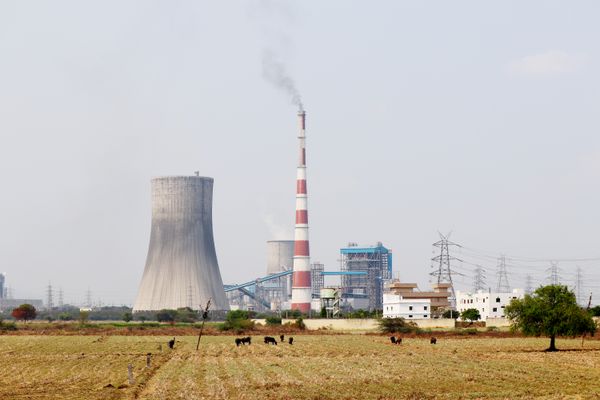
Start with what comes out of the stack. Incinerating a tonne of municipal solid waste releases somewhere between 0.7 and 1.7 tonnes of CO2, fossil and biogenic combined, per the CE Delft work for Zero Waste Europe. The fossil slice (the part from burning plastics and synthetic textiles, never the food or paper) runs roughly 250 to 600 kg per tonne of waste depending on composition. Only that fossil slice is what the EU ETS would make you surrender allowances against, at least in the scenario the Commission is most likely to adopt first. The combustion kit is almost beside the point. A Martin moving-grate line and a Hitachi Zosen mass-burn furnace surrender on the same basis, the fossil carbon in the feed, not the technology that burns it.
So the gate-fee impact isn't one number. It's a function of two things you don't fully control: the carbon price, and how much of your tonne the rules decide is fossil. At today's allowance near 70 euros, the fossil-only hit is about 35 euros a tonne of waste; at the 2030 price it climbs toward the top of the range above, and it only gets there if biogenic CO2 is pulled into scope alongside the fossil share.
Now lay that against a typical European incineration gate fee of roughly 80 to 150 euros per tonne [market range]. The fossil-only case at the 2030 price adds something close to half again on top. The fossil-plus-biogenic case can nearly double it. That cost doesn't stay at the plant; it flows straight through to the municipality and then to the ratepayer, which is exactly why the people who finance these facilities tell you to underwrite the tipping fee, not the megawatt. A carbon charge on the gate fee hits the revenue line the debt is actually secured against.
And these aren't short contracts. Municipal waste-treatment agreements routinely run 15 to 25 years, so a deal signed in 2026 will live through the entire ETS phase-in, opt-out window and all. Pricing the carbon risk in now isn't optional. It's the difference between a contract that ages well and one that gets reopened at the worst possible moment.
What you surrender depends on a number you probably can't defend
The fossil-biogenic split isn't measured in real time at most plants. It's derived, through standard waste-composition assumptions, periodic sampling, or the C-14 radiocarbon method on flue gas. The Monitoring and Reporting Regulation, Commission Implementing Regulation (EU) 2018/2066, sets out which methods qualify and what documentation a verifier will accept. And I've watched the gap open up right there, in the space between what a plant reports and what it can prove.
On a Spanish WTE project I reviewed for EU Taxonomy alignment in 2023, the biogenic-share verification failed at year-two reporting. The plant had used a default composition table from commissioning, never re-sampled, and the real plastic fraction had crept up as the catchment's recycling rate stalled. The reported biogenic share couldn't survive the verifier's own sampling. Under MRV-only rules that was a reporting finding, an embarrassment with a remediation plan attached. Under a live surrender obligation it would have been a direct cost: every point of overstated biogenic share is fossil CO2 you didn't buy allowances for, and the verifier trues it up after the fact.
Diligence is a documentation exercise dressed as a technical one. Most plants I see can quote their biogenic share to three significant figures and can't produce the sampling record that would survive a challenge. Three figures, no traceability. That was survivable while the regime was monitoring-only. It stops being survivable the moment the number carries a price.
The opt-out is a trap
The reform built in an escape hatch. Directive 2023/959 added a review clause, and under it a member state can opt its incinerators out of the surrender obligation until 31 December 2030, even if the July 2026 report greenlights inclusion from 2028. On paper that's two years of relief. In practice it's a way to arrive at the obligation less prepared than the operators who didn't blink.
Why? Because the hard part isn't paying for the allowance. It's building the monitoring record that makes your fossil share defensible, and that record takes years of clean, traceable sampling to assemble. An operator who goes live in 2028 will have four years of MRV data and two years of real surrender behind them by 2030. An operator who waited will be starting the sampling clock the same year the bill comes due. Permits don't fail at issuance; they fail at renewal, and monitoring obligations behave the same way. The cost shows up when you have to prove the number, not when you first write it down.
I'd put it plainly to any operator weighing the opt-out: you're not buying time, you're deferring the only work that matters and keeping the bill.
Recycle-versus-burn, repriced
So does this push waste back to landfill? That was the industry's loudest objection, and the April 2026 Zero Waste Europe study took it head-on. Its answer: probably not. Landfill taxes and mandatory pre-treatment requirements under the Waste Framework Directive (2018/851) already make landfilling more expensive than incineration across most member states, before you add any carbon cost to the burner. A price on incineration widens the gap between recycling and disposal. It doesn't reorder the disposal options themselves.
What it does reorder is feedstock. A carbon price on fossil CO2 is a price on the plastic in your feed. Pull the plastics upstream and your surrender obligation falls almost tonne for tonne, because a tonne of mixed plastic burns to two or three tonnes of CO2. That is the behavior the policy is built to drive: sort harder, and stop paying carbon to burn what you could have recovered. But it lands unevenly. The plants that can act on it already know their fossil-fraction load by stream and by shift, which is a measurement problem before it is a sorting one, and the kind of thing AI-driven characterization exists to handle. The diversion-first operators, the ones already pairing upstream separation with downstream recovery as part of broader zero-waste-to-landfill solutions, will surrender allowances against less plastic. The rest will pay carbon on material they could have pulled, and pass it to the gate.
Actually, that clean 74-euro figure only holds if the Commission starts with a fossil-only basis. The April 2026 modeling treats fossil-plus-biogenic as a live scenario, not a fringe one, and several environmental groups are pushing for it. If that's where this lands, the gate-fee shock roughly doubles and the recycling incentive sharpens with it.
What the next four years look like
Project the numbers forward and the shape is clear enough. At 108 euros by 2030 on a fossil-only basis, the incineration-heavy member states are looking at gate fees 70 to 100 euros higher per tonne inside this decade, with the biogenic-inclusive scenario pushing past 130. The opt-out moves the date, not the math. And the operators who treat 2024 through 2028 as a grace period rather than a sampling window will find out, the way my Spanish client did, that the number you can't defend is the number you pay full freight on.
My standing bet, and I'll own it if it's wrong: the EU Taxonomy will reject something close to 30% of current WTE projects at the Article 9 fund level over the next three years, and biogenic-share documentation will sit in the top three reasons. I've been wrong about derived-from interpretations before, so I hold it loosely. But the direction isn't in doubt. The carbon cost on EU ETS waste incineration isn't coming. The monitoring obligation that prices it is already three years old, and it's quietly recording who did their homework.
Disclosure: Elena Ruiz advises waste-to-energy developers on permitting and ESG compliance and is published by Renewable Waste Energy.
Sources & Notes
- The emission factors (0.7 to 1.7 t CO2 per tonne of MSW, of which roughly 250 to 600 kg is fossil) and the 108 EUR/t 2030 price forecast come from CE Delft's 2025 update for Zero Waste Europe, "Waste Incineration under the EU ETS."
- The 74 to 132 EUR/t gate-tariff range, and the finding that a carbon price doesn't push waste back to landfill, are from Zero Waste Europe's April 2026 report on including incineration in the ETS.
- For how that carbon cost passes through to municipal gate and tipping fees, see Reloop's March 2026 analysis.
- The timeline (MRV-only since 1 January 2024, the 31 July 2026 Commission report, surrender targeted from 2028, and the opt-out to 31 December 2030 under Directive 2023/959) follows Carbon Market Watch's "Waste no time."
- The biogenic-share caution draws on RWE project experience: an EU Taxonomy alignment review at a Spanish WTE facility in 2023, where year-two verification turned up a default composition table with no re-sampling behind it. Anonymized per client confidentiality.
Researched and written by OWI editorial staff. Technical review by RWE engineering. AI tools used for drafting assistance.