Why Does MRF Fire Detection Pay for Itself Before It Catches a Single Fire?
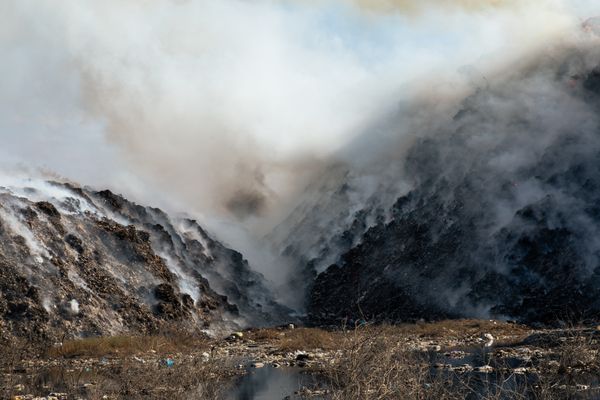
A pouch cell fails quietly before it fails loudly. Crush a phone battery under a loader bucket, the separator tears, and for somewhere between a few minutes and half an hour the only evidence is a rising temperature under two feet of old corrugated. Lithium battery fires at waste facilities hardly ever start as fires. They start as a thermal anomaly nothing in the building can see, because the object radiating heat is buried inside the pile it's about to ignite.
So I get twitchy when a vendor demos fire detection on a clean, empty conveyor with a road flare sitting on it. That demo proves the camera works. It proves nothing about the geometry you actually have, which is a forty-foot pile with the interesting voxel somewhere in the middle of it.
The scale of the problem isn't in dispute. Fire Rover's annual tally, reported by Resource Recycling in March 2026, counted 448 publicly reported fires across US and Canadian waste and recycling operations in 2025, around a hundred of them catastrophic, with total damage near $2.5 billion. Waste, paper and plastic facilities took about half of those, and that share is why MRF fire detection stopped being a discretionary line item. Vaping devices get a lot of the blame, and the arithmetic supports it: a disposable vape is a lithium cell with no removable-battery design intent at all.
What I want to argue is narrower than "install cameras." It's that the payback line most facilities can defend on paper doesn't run through the fires you prevent. It runs through your insurance file.
San Carlos, 2016, and a deductible that moved 300-fold
EPA's 2021 study of lithium battery fires in waste management walks through what happened to the Shoreway Environmental Center in San Carlos, California, and it's the most useful case in the whole document because the fire is the least interesting part of it. Shoreway burned in 2016. Direct damage came to $8.5 million, soot corroded equipment the flames never touched, and RethinkWaste furloughed fifty employees while the plant was down.
Then the renewal came around. Their insurer dropped them. Dozens of likely replacements declined to bid. The agency ended up assembling coverage from seven different sources because no single firm would take the whole risk, its annual premium went up sixfold, and its required deductible rose by roughly 300-fold, which in practice means partially self-insuring a plant you already own. They now hold over a million dollars in extra reserve against a repeat.
After the fire, they installed countermeasures at Shoreway that they say "wildly exceed" minimum standards set by the relevant fire codes. These tools include sprinklers installed over all major equipment, an increased number of high-powered hoses, and heat-activated ceiling vents, which they credit for saving the structure from being completely engulfed in the fire.
Same year, worse outcome: in 2016 a MRF in Plano, Texas lost its entire building to a fire likely started by a lithium cell, and the replacement plant that opened in 2019 cost $30 million [both incidents per EPA 530-R-21-002]. Shoreway got to keep its structure. Plano rebuilt from nothing.
Underwriters read those two files the same way, and they've adjusted. Ryan Fogelman, who compiles the fire counts, told Resource Recycling in a February 2026 piece on the insurance response that carriers now want proof of engineered controls rather than a written policy and a rack of extinguishers, and that the specific asks are detection and suppression documentation, separation and containment, third-party monitoring, and operational monitoring analytics. Read that last item closely, because operational monitoring analytics is not a description of a camera. It's a description of a data product.
Two feet of OCC and the camera goes blind
Infrared is a surface measurement. A long-wave camera reports the apparent temperature of the outermost thing in its line of sight, corrected by an emissivity value you guessed at, and paper emits differently from wet film, which emits differently from bare aluminum. None of that is a reason to skip the deployment. It's a reason to size your expectations to the sensor's recall, because a cell venting under a pile becomes visible only once conduction and convection carry the heat to a surface the lens can see. At that point you're measuring a fire rather than getting ahead of one.
A confusion matrix tells you more than any single accuracy number will, and on a tipping floor the false-positive column is where the money sits. Hot engine blocks on a loader that just parked. Sun-warmed steel on a roll-up door. Freshly shredded material coming off a Vecoplan grinder, which runs genuinely warm and looks exactly like a developing hot spot to a naive threshold. Every one of those trips a temperature alarm, and every trip that gets dismissed by an operator teaches the operator to dismiss the next one.
Which is why I distrust any spec sheet that leads with frame rate. A smoldering pile doesn't need 30 FPS, it needs a temperature trend held over ten or fifteen minutes with the ambient drift subtracted. Vendors quote FPS because it's a number they can win on. Actually, let me qualify that: on a conveyor downstream of a shredder, where material clears the field of view in under two seconds, frame rate does matter, and there the answer is a line-scan geometry rather than a pan-tilt head sweeping a bunker.
Calibration drift shows up in the data before it shows up on the floor. Every thermal camera on a tipping floor is looking through a germanium window that accumulates a dust film, and that film attenuates in the eight-to-fourteen micron band without ever looking dirty on a visible-light feed. Your alarm threshold gets harder to reach and nothing in the room announces it. I learned the general version of this on a near-infrared moisture model over an RDF dryer in 2024, where the sensor walked off by roughly three percent a month until we stopped treating recalibration as a maintenance ticket and moved it inside the control loop. Same discipline applies here: put a small reference target of known emissivity in a corner of every camera's frame, log its apparent temperature every hour, and you'll see the window fouling as a slope weeks before you'd see it as a missed detection.
None of this holds uniformly. An open-sided transfer station moving forty tons a day, where the pile is one loader bucket deep and someone is standing next to it all shift, gets very little from a fixed thermal array; a fire extinguisher and a steel bucket of sand cover that risk at a fraction of the cost. Outdoor storage piles are a different optical problem again, with solar loading swamping the signal you want through the afternoon. And if your carrier isn't underwriting on engineered controls, the insurance half of the argument evaporates and you're back to justifying the system on avoided losses alone, which is a much harder sell to a board that hasn't had a fire yet. Waste-to-energy plants appear in EPA's data too, and a bunker in a waste-to-energy technology stream has the same buried-source geometry with a deeper pile on top of it.
The alarm nobody is there to dismiss
The single most useful data set in that EPA report came from a landfill supervisor in the Pacific Northwest who started writing down every battery fire on June 12, 2017, and logged 124 of them over the following three years, rising from 21 in 2018 to 47 in 2020. Almost all of them stayed small. Staff spotted the smoke, doused it, bagged the cell, moved on.
Two didn't, in May 2019 and again in May 2020, and both of those happened outside working hours and needed the local fire department. That's the whole business case in one comparison. Detection during a staffed shift is largely redundant with human eyes. Detection at 2 a.m. is the entire product, and 2 a.m. is also when a false positive costs the most, because there's nobody on site to walk over and confirm that the warm spot is a loader that parked at eleven.
So the alarm has to arrive somewhere with a procedure attached. RethinkWaste's crews learned to stop trying to quench a venting cell, because quenching often fails outright or lets the cell reignite later; they pull the battery and the material around it, drop it in a barrel of sand, and let it burn itself out. That's a two-minute procedure that only works if someone knows within ten minutes. Third-party monitoring exists precisely to close that gap, and it's one of the controls carriers are now asking about by name.
And the by-product is the thing you'll be graded on. Every alarm, every dismissal, every temperature excursion that resolved on its own becomes a row in a table. Twelve months of those rows, with timestamps and dispositions, is the difference between telling an underwriter you manage battery risk and showing them. Does the detection model matter less than the event history it writes down? For the purposes of your renewal, on the evidence above, yes, which is the useful reason to care about waste intelligence software here. Operators already running threshold monitoring for landfill diversion reporting have the harder half built.
Fewer cells arriving would do more about lithium battery fires at waste facilities than any camera will, and that is moving, slowly. EPA is drafting a rulemaking that would carve lithium batteries out as their own universal waste category under 40 CFR Part 273, with a proposal expected in 2026 and a final rule a year or more behind it, and states have been running ahead of the federal timeline with their own programs. We've written before about how the 2026 battery EPR statutes allocate that cost between producers and collectors, and the short version is that even a well-run take-back program changes the arrival rate rather than zeroing it. Facilities building toward zero-waste-to-landfill solutions still need a dedicated battery route off the floor, because a cell you divert into a mixed bale is a cell you've relocated rather than removed.
If you're writing a specification this year, give sensor selection less of the review than the two decisions that will settle whether the system pays for itself: a trend threshold tuned against your own logged ambient rather than a vendor default, and a named off-hours response path with a sand barrel at the end of it, both of them logging every event from day one so that by the time you sit down with your broker you're handing over a year of your own data instead of an invoice for hardware.
Sources & Notes
The Shoreway and Plano cases, the Pacific Northwest landfill log, and the insurance aftermath all come from EPA's July 2021 report on lithium-ion battery fires in waste management and recycling (EPA 530-R-21-002), which remains the only federal compilation of its kind and is explicit that the 245 fires it documents are an undercount.
For the 2025 totals, see Resource Recycling's March 2026 coverage of the Fire Rover annual fire report. The underlying count is of publicly reported incidents only, so it shares the EPA undercount problem.
Carrier expectations around engineered controls are drawn from Resource Recycling's February 2026 piece on the insurance market. No premium figures are published there; the sixfold and 300-fold numbers in this article are Shoreway's, from the EPA report.
Current universal waste standards are at 40 CFR Part 273 in the eCFR. Lithium batteries are not yet a distinct category there; the proposed-rule timing above is a published schedule and has slipped before.
Disclosure: I build computer vision and sensor systems for waste processing at Renewable Waste Energy, which includes detection stacks of the kind described here.
Researched and written by OWI editorial staff. Technical review by RWE engineering. AI tools used for drafting assistance.
Cite this article
Nina Chowdhury, “Why Does MRF Fire Detection Pay for Itself Before It Catches a Single Fire?,” Optimal Waste Intelligence, September 21, 2026, https://optimalwasteintelligence.com/posts/lithium-battery-fires-waste-facilities.
You’re welcome to quote this article with attribution and a link to the original.